This year, the theme for Speech Pathology Week is Communicating for Life. We will highlight the role Speech Pathologists play in supporting families and children’s quality of life as they grow. We will be showcasing how communication develops through the preschool lifespan and walk through the communication milestones to expect at each age and stage of development. We will also be sharing some tips on how to help build your child’s communication skills.
Monday:
Explorers (0-1 years):
At the Grove our Explorers are at the early stages of developing their communication skills. Don’t miss their attempts at talking to you – these might sound like cooing (“oo oo aah”) or babble (‘bubadaba”) right now, but these are early ways that babies have conversations. We can respond by giving lots of eye contact and copying the sounds they make back to them. Soon we may start to hear their first words. Our babies also start to recognise familiar voices and faces and may turn to look when we call their own name.
Top Tips for Families of Explorers:
Sing lots of songs
Choose songs that are repetitive, don’t have too many words, and have actions and movement. It is much better if you are the one singing the songs, rather than playing it from a phone or tablet device. This helps your child to connect with you and learn language and interaction skills from you. Once they are familiar with the song your child will start to anticipate the words and actions and may join in with actions or giggles.
As your child starts to say words, you can try to encourage them to use them in a song. When singing, take a pause before a word or action. Leave time to let your child respond by doing the action or saying the word. For example, when singing Row Row Row Your Boat, sing it a few times through then WAIT before starting again. Your child may rock or make a sound to tell you they want you to keep going.
Tuesday:
Adventurers/Pioneers (1-2 years):
Our Adventurers and Pioneers are very busy expanding their vocabulary. They understand many more words than they use, and can now follow simple instructions in routines, such as ‘put your shoes on’. Their vocabulary of words they can say is also starting to grow, and we will start to see them join words together.
Top Tips for Families of Adventurers/Pioneers:
Add words
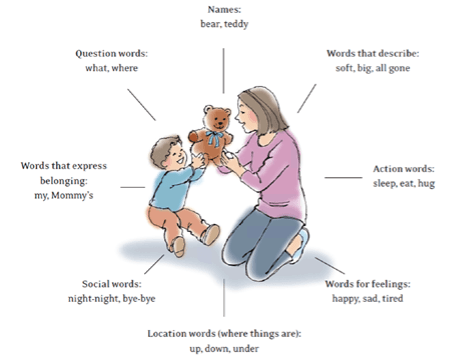
Help your child to build their word combinations by adding an extra word on to what they say. For example, if your child says ‘teddy’, you could say: “Yes, big teddy”, “Where’s Teddy?”, “Teddy’s sleeping” or “Bye teddy”.
This image, take from The Hanen Centre (www.hanen.org) shows the different types of words we can add:
Wednesday:
Voyagers (2-3 years):
Our Voyagers have lots to say now! Their vocabulary is continuing to grow, and they may be talking in short sentences. They are still developing all of their speech sounds, so some words will sound unclear. They are learning how to ask and answer questions and are becoming keen little learners.
Top Tips for Families of Voyagers:
Add more words and sentence shapes
Now we want to expand the length and type of sentences your child is using. Think copy, add or change. Copy what they have just said, and add another word or two, or change some words to make the sentence more complex.
For example, if your child says ‘go car’, you could say, “Yes, push the car… go!”; “It’s a fast car”; “Oh-oh, the car is broken”; “We drive the car, brrmm”; “I like your car, it’s shiny”.
Thursday:
Creators (3-4 years):
Our Creators’ understanding of words and their spoken vocabulary has continued to expand. They are now using long sentences to talk and may start to use joining words to talk about things that have happened to them. They also are starting to learn that some words sound similar, and how words are made up of sounds. This is the emergence of phonological awareness, which helps to develop literacy skills.
Top Tips for Families of Creators:
Reading books together
Books have been a great tool since birth for developing attention and language skills, but now is a great time to use them to build your child’s phonological awareness skills. These early literacy skills such as rhyming, clapping syllables, and finding the first or last sound in a word can help your child to understand how sounds make words, which will support them to learn to read.
For example, you could start teaching your child about rhyming with the Dr Seuss classic “The Cat in the Hat”. As you read the story start to emphasise the rhyming words, e.g.
We looked! Then we saw him
Step in on the mat
We looked! Then we saw him
The Cat in the Hat!
Talk about how those words sound the same at the end. Encourage your child to find the rhyming words in the book. Once they can do this, maybe they could have a go at making up some extra rhyming words (silly words count!).
Friday:
Achievers (4-5 years):
Our Achievers are increasingly confident communicators and are now speaking in long sentences and telling some simple stories. They can follow instructions with multiple steps and are starting to use language to think about and solve problems. Most of their speech sounds have developed (apart from ‘r’ and ‘th’) and they are usually able to be understood. They are becoming better conversationalists and are getting better at taking turns.
Top Tips for Families of Achievers:
Ask questions to develop problem-solving skills
Talk about events that have happened to your child or discuss stories and TV shows. Start to encourage your child to think about what has happened to the people or characters and why. Some examples of questions that develop reasoning and problem-solving skills are:
Where will they go?
What would happen if…?
Why did they do that?
Why wouldn’t that work?
How do you know they feel that way?
What would you do?
Meet the author
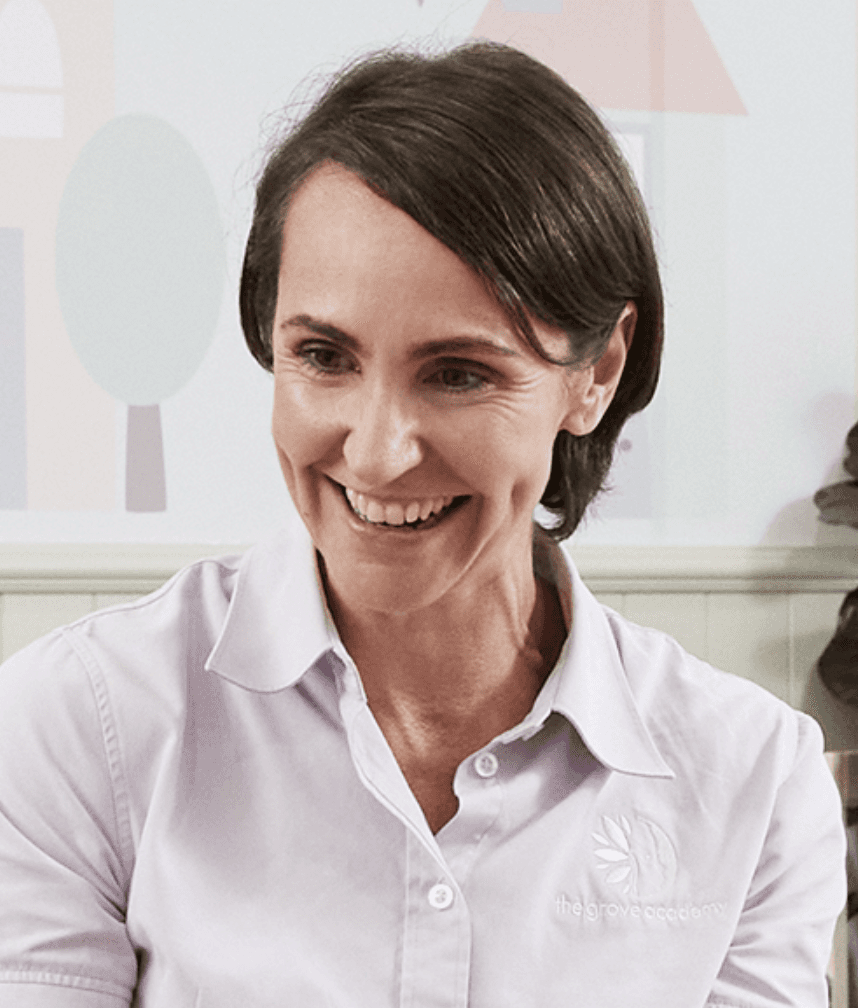
It is exciting for me to share my passion for developing children’s communication with the children, families and staff at the Grove Academy’s services. With over 20 years of experience as a Speech Pathologist working in Australia and the United Kingdom, I bring an innovative approach to supporting children with language and communication needs through early education.


Share:


Other recent posts: